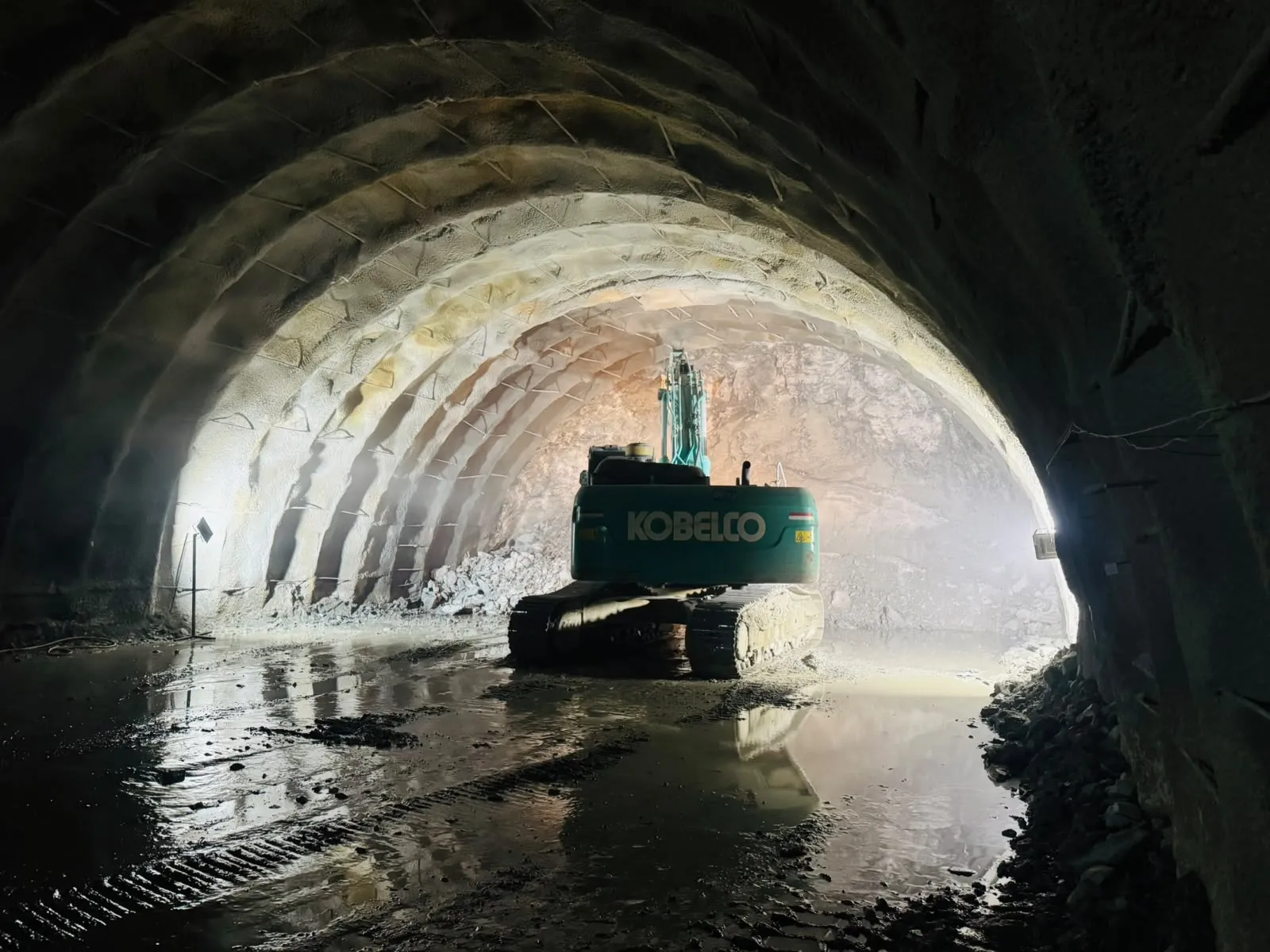
Nepal's terrain makes tunnels a necessity, not a luxury. On the Kathmandu-Terai/Madhesh Fast Track — the expressway intended to cut travel time between the capital and the Terai plains from roughly six hours to about two — the alignment has to pass straight through the Mahabharat range. That's the job on Lot 8B: double-lane dual-carriageway expressway road, a tunnel, a bridge, and slope stabilisation, on the EPC contract awarded for CH 11+120 to CH 16+118.
Why you can't just cut through the mountain from the top
Open-cut excavation on Himalayan slopes this steep would mean enormous cut faces, an unmanageable volume of spoil, and slopes that are geologically unstable to begin with. A bored tunnel avoids all three problems, but it introduces a different set: you're now excavating rock that has never been exposed to the surface, under overburden that can be hundreds of metres deep, in geology that in the Himalaya is notoriously young, folded, and fractured compared to older mountain ranges elsewhere in the world.
The drill-and-blast cycle
Lot 8B is being driven by conventional drill-and-blast, the standard method for tunnels this length through variable hard-rock geology. Each advance follows the same cycle:
- Drilling — a hydraulic drill jumbo bores a pattern of blast holes into the tunnel face, typically 3-4 metres deep per round.
- Blasting — a timed charge sequence breaks the round without over-shattering the surrounding rock, which would compromise stability.
- Mucking out — wheel loaders and dump trucks clear the broken rock (muck) from the heading before the next stage can begin.
- Support — lattice girders go up immediately, followed by systematic rock bolting and a sprayed shotcrete primary lining, before the next round is drilled.
That last step — support — is not optional and it is not fast-followed at a leisurely pace. In fractured Himalayan rock, the interval between exposing new ground and getting primary support in place is the single biggest safety variable in the whole operation.
Portals are their own project
Before a tunnel boring crew ever reaches "real" tunnelling, the portal — where the tunnel meets daylight — has to be cut and stabilised. Portal slopes in the Himalaya are frequently the weakest ground on the entire alignment: weathered, loose, and exposed to monsoon runoff. On Lot 8B that meant slope-specific shotcrete and rock-bolt stabilisation programs (including work at what our site records reference as "Slope 6, T1P1") run in parallel with the heading advance, not as an afterthought once the portal was already cut.
What this actually requires from a contractor
Tunnelling isn't a scaled-up version of road-building — it's a distinct discipline that needs geotechnical engineers reading the face in real time, a drill jumbo and shotcrete manipulator crew working to a strict cycle time, and a safety culture where nobody advances past unsupported ground because the schedule says so. Motidan's Lot 8B crew includes senior tunnel engineering staff dedicated to this contract, working alongside our standard heavy-civil teams already mobilised on adjacent expressway sections.
You can see photos from active work on the tunnel heading, the portal, and slope stabilisation in our project gallery, or read the full contract scope on the projects page.